

Case Study
Beneteau First 50.
Melbourne to Osaka.
5,500 nautical miles. Five weather systems. Two crew. A mainsail built to a campaign budget that never let them down, and an A2 that took them from cautious to committed. Then they turned around and raced the Hobart.
The Brief
One Spinnaker.
Five Weather Systems.
The Melbourne to Osaka is one of the longest ocean races in the Southern Hemisphere; 5,500 nautical miles, double-handed, crossing five distinct weather systems from the Southern Ocean to the equatorial calms and back into the North Pacific trades. A 13-ton Beneteau First 50 isn’t a stripped-out racing machine. It’s a cruiser-racer carrying the weight of liveability, and that changes the way you think about every sail on board.
The owner came to us needing an A2 asymmetric spinnaker that could do two fundamentally different jobs. In light air near the equator, the doldrums, where wind drops to single digits and the boat wallows, the sail needed enough projected area to keep the boat moving, floating it through the calms rather than stalling. But the same sail also had to be manageable in 25+ knots of breeze, when the boat is surfing and the loads go through the roof. And it had to be managed by two people, one of whom might be asleep.
At a Glance
Boat: Beneteau First 50 (13 ton)
Race: Melbourne to Osaka
Distance: 5,500 nm
Crew: Double-handed
Sails delivered: Triradial main + A2 spinnaker
Main construction: Sustainable laminate, triradial
A2 construction: Superkote nylon, graded panels
Total miles sailed: ~12,000 nm
The Design
Superkote Nylon.
Graded for the Conditions.
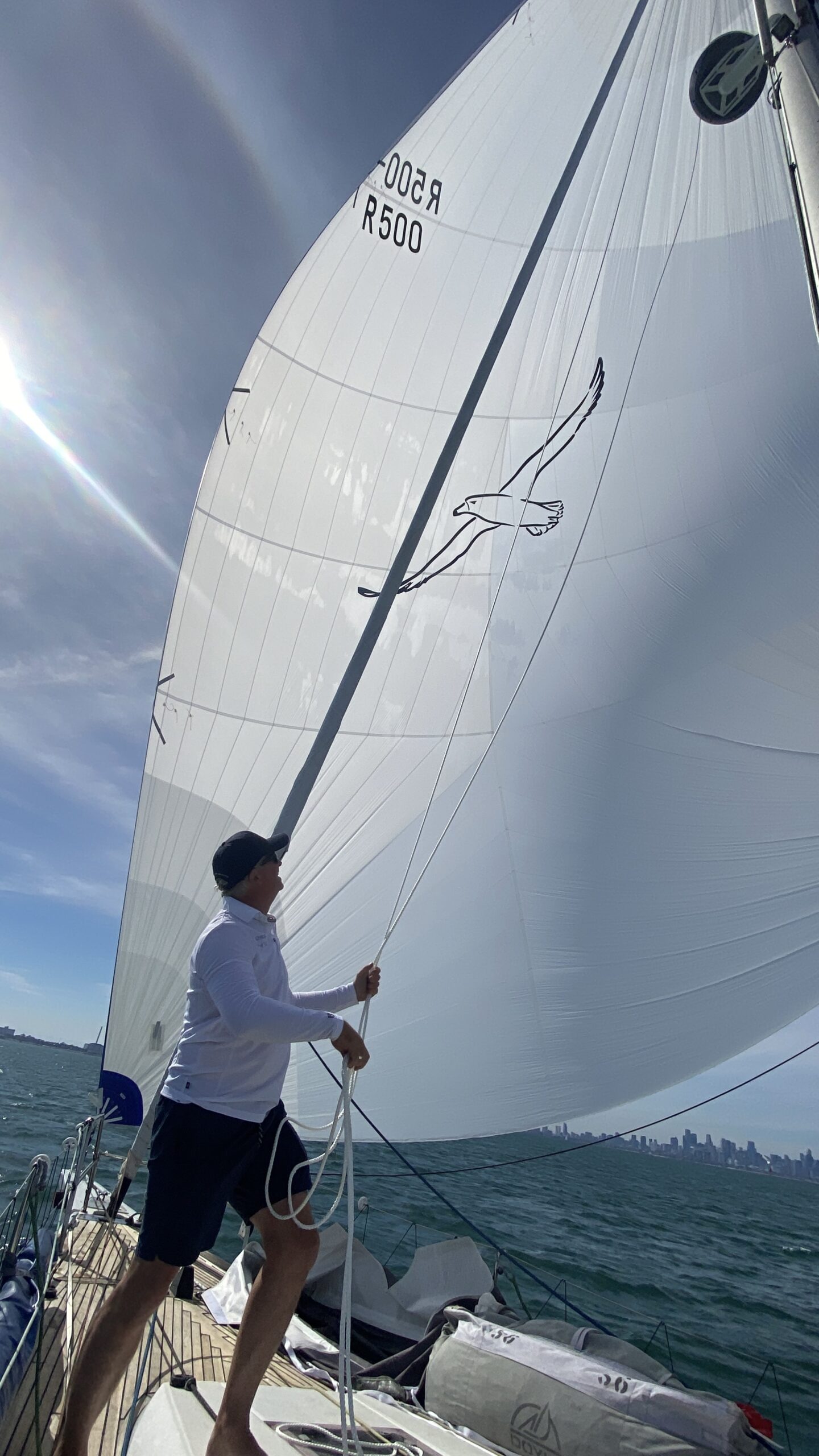
We built the A2 in Superkote nylon, and this is where the material choice gets interesting. Superkote has a unique property: the elongation profile stays consistent across different fabric weights. That means you can use heavier cloth in the high-load areas and lighter cloth where you need projection, and the sail stretches uniformly across the panel joins. With conventional nylon, mixing weights creates hard spots where the fabric transitions, the heavier panel resists stretch while the lighter one distorts, and you end up with a sail that changes shape unpredictably under load. Superkote eliminates that problem.
We used heavier Superkote in the luff and along the primary load paths, the areas taking the most punishment when the sail is loaded up in 25 knots. The leech panels were built lighter, giving the sail the projected area it needed to keep a 13-ton boat moving through the equatorial calms. The result is a sail that looks and feels like one continuous surface, but underneath it’s engineered with different structural properties across its area. Heavy where it needs to be strong, light where it needs to fly.
Built for Confidence
Stability was the other critical design goal. On a double-handed ocean race, the spinnaker has to be manageable by one person while the other sleeps or handles navigation. If the sail oscillates or collapses unpredictably, the crew won’t fly it, and a spinnaker that stays in the bag because the crew doesn’t trust it is a wasted sail. We shaped the A2 for inherent stability: an entry that resists collapsing, with enough depth in the body to generate power without the oscillation that makes big kites frightening in a seaway.
The sail was rigged with a spinnaker sock for deployment and retrieval. On a fully crewed boat, you’d do a conventional hoist and drop. But double-handed, a sock lets one person manage the entire evolution, deploy, gybe, douse, without drama. The sock was sized and specified as part of the sail design, not an afterthought.
The Mainsail
Triradial Laminate.
Campaign Budget. Ocean Proof.
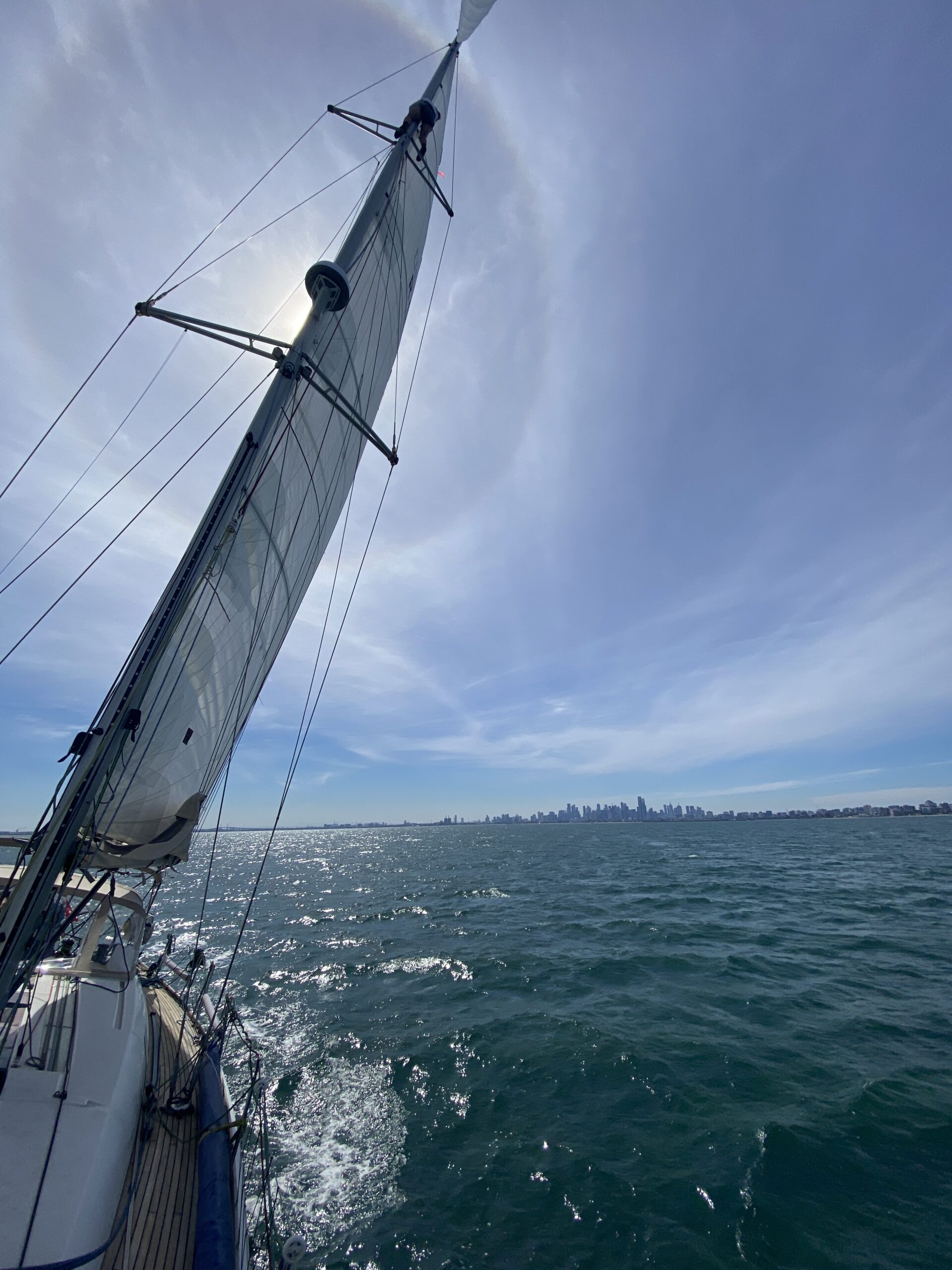
We also built the mainsail for this campaign, and the brief was shaped as much by budget as by performance. An ocean racing campaign isn’t just sails, it’s boat preparation, safety gear, provisioning, communications, entry fees, and getting the boat to and from the start line. The sail budget has to work within that reality. Some of the higher-end membrane and composite materials simply weren’t in the budget, and we weren’t going to pretend otherwise or push the owner toward something that compromised the rest of the campaign.
Sustainability mattered too. One of the co-skippers was completing her doctorate in marine plastics, so the environmental footprint of every material choice was part of the conversation. We were proud to source a cost-effective laminate with strong sustainability credentials, a material that let us build a triradial main the crew could trust for 5,500 miles of ocean racing without blowing up either the budget or the environmental brief.
A triradial layout was the right call for this sail. It let us orient the fibre paths to follow the primary load lines through the sail, getting the most structural performance out of the laminate we had. It wasn’t going to have the ultimate long-term lifespan of a premium membrane, or Dimension-Polyant Hydranet Radial, (which would have been the best-in-class option) and we were upfront about that. But it was going to be reliable, it was going to hold its shape through the race, and it was going to give the crew one less thing to worry about in a campaign that demanded their full attention elsewhere.
The Outcome
From "Never Above 15"
to Flying at 25.
The crew started the Melbourne to Osaka saying they’d never fly the A2 above 15 knots. By the end of the race, they were regularly flying it at 25. That progression tells the whole story, the sail was stable enough and predictable enough that the crew’s confidence grew with every mile. They went from cautious to committed, because the sail never gave them a reason to doubt it.
Through the equatorial calms, the lighter leech panels gave the A2 enough projected area to keep 13 tons moving in 6–8 knots of breeze. The boat didn’t stall the way it would have with a heavier, flatter sail designed purely for heavy air, or one made with a cheaper, heavier cloth. And when the North Pacific trades filled in and the breeze built to 20–25 knots, the heavier luff construction held shape and resisted the distortion that would normally force a crew to douse. The Superkote’s consistent elongation profile meant the sail transitioned smoothly between light and heavy air, no sudden shape changes, no panel-join hard spots, just a progressive increase in loading that the crew could manage intuitively.
The mainsail did exactly what it needed to do, 5,500 miles of ocean racing without a failure, without a moment where the crew doubted it. And the story didn’t end in Osaka. On the return leg, the boat came via Brisbane for some maintenance, and then raced the Sydney Hobart fully crewed. In another year marked by severe weather and a high withdrawal rate, a first-time Hobart crew brought the boat home safely. Nearly 12,000 nautical miles on a sail built to a campaign budget, with a sustainability brief, that never let them down.
That’s what wardrobe planning within a real campaign looks like. Not every sail needs to be the most expensive option on the table. Sometimes the right sail is the one that fits the budget, fits the brief, and gives the crew the confidence to push the boat when it matters. Both sails did that, from Melbourne to Osaka, and all the way to Hobart.
Planning an Offshore
Campaign?
Every ocean race has its own weather profile and its own demands. We map the conditions, design for the range, and build sails that give your crew confidence from the first mile to the last.