

Case Study
Dark and Stormy.
Sydney Hobart 2024.
A 37-foot boat with a 40-foot rig, needing a first-timer Sydney Hobart wardrobe that would set the owner up for shorthanded ocean racing. Two sails. No compromises.
The Brief
A Hobart Wardrobe
Built for What Comes Next.
Dark and Stormy is a 37-foot boat carrying the rig of a 40 footer, a combination that creates real design tension. More sail area than you’d expect for the hull weight, which means the sails have to manage a wider range of loading than a standard 37-footer. The owner came to us with a clear brief: build sails for the 2024 Sydney Hobart, but design them so the boat could transition into shorthanded ocean racing without replacing the wardrobe.
That second requirement changed everything. A fully crewed Hobart boat can carry more sails, each optimized for a narrower wind range. A shorthanded boat needs fewer sails that each work harder across a wider envelope. The challenge was designing a wardrobe that performed at the pointy end of the Hobart fleet while being simple enough for two people to manage offshore in deteriorating conditions.
At a Glance
Boat: 37 ft / 40 ft rig
Race: Sydney Hobart 2024
Future use: Shorthanded ocean racing
Sails delivered: Main + Hanked J2
Main construction: Polyester cord laminate
Key feature: Survival-depth 3rd reef
The Mainsail
Polyester Internalled Laminate.
Three Reefs. Zero Excuses.
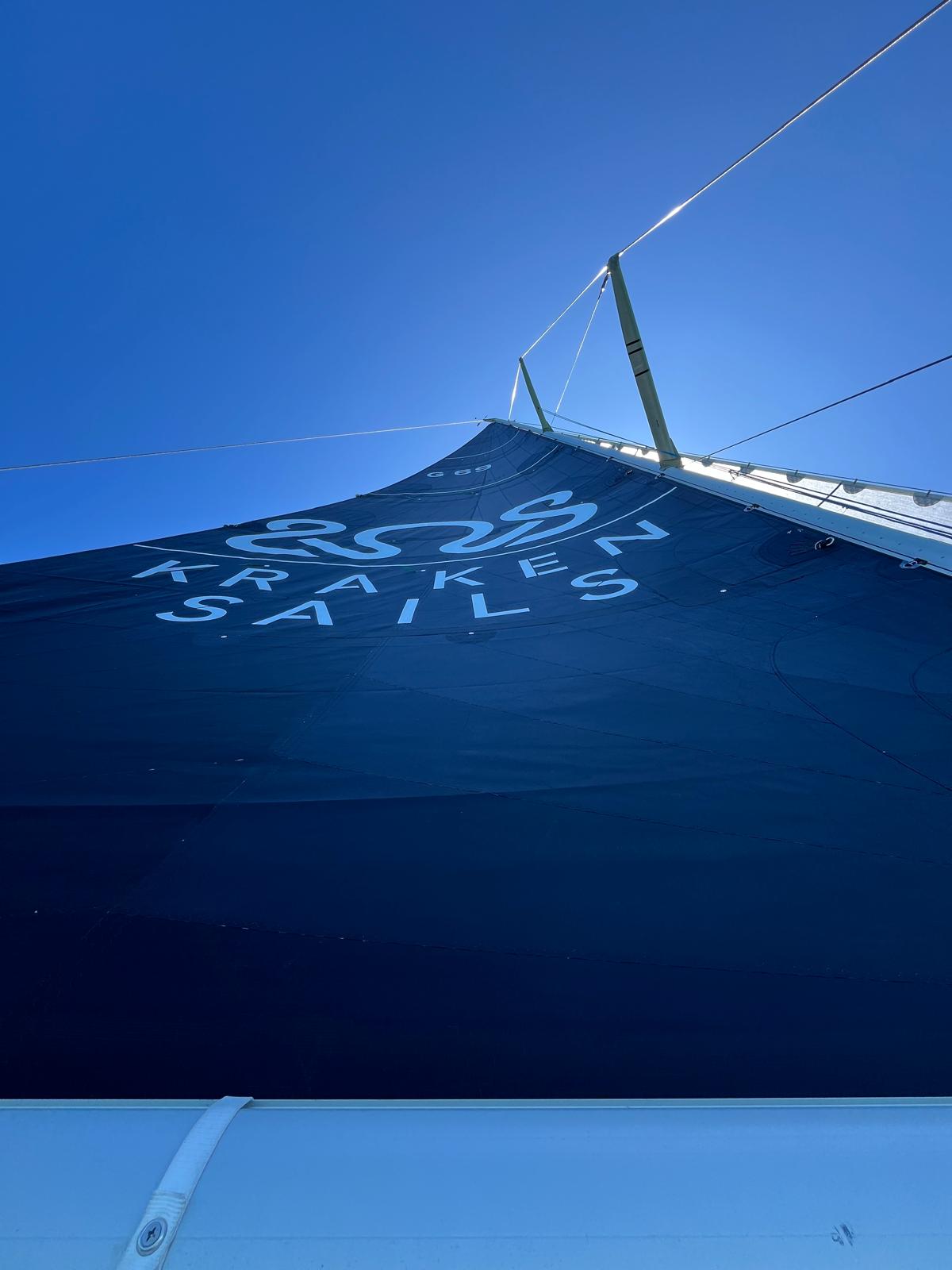
We built the mainsail in polyester cored laminate, a material that gives you the shape-holding performance of a laminate with the durability and repairability that offshore racing demands. On a boat that’s going to be shorthanded in the Southern Ocean, you can’t afford a sail that degrades after one hard season. Polyester holds its shape through thousands of loading cycles, and if something does go wrong, it can be repaired with materials you’d carry on board.
The critical design decision was the reefing. We built three reef points, with the third reef taken unusually deep, at trysail depth. The thinking was straightforward: in shorthanded conditions offshore, setting a trysail is a major evolution. You’re sending someone to the mast in potentially 45+ knots to drop the main completely, bag it or lash it, then hank on and hoist a separate sail. With a crew of two, that’s dangerous and slow. A super-deep third reef means you can reduce to survival area without leaving the cockpit. One reef line, one winch, done.
The Headsail
A Hanked J2 That
Covers Half the Range.
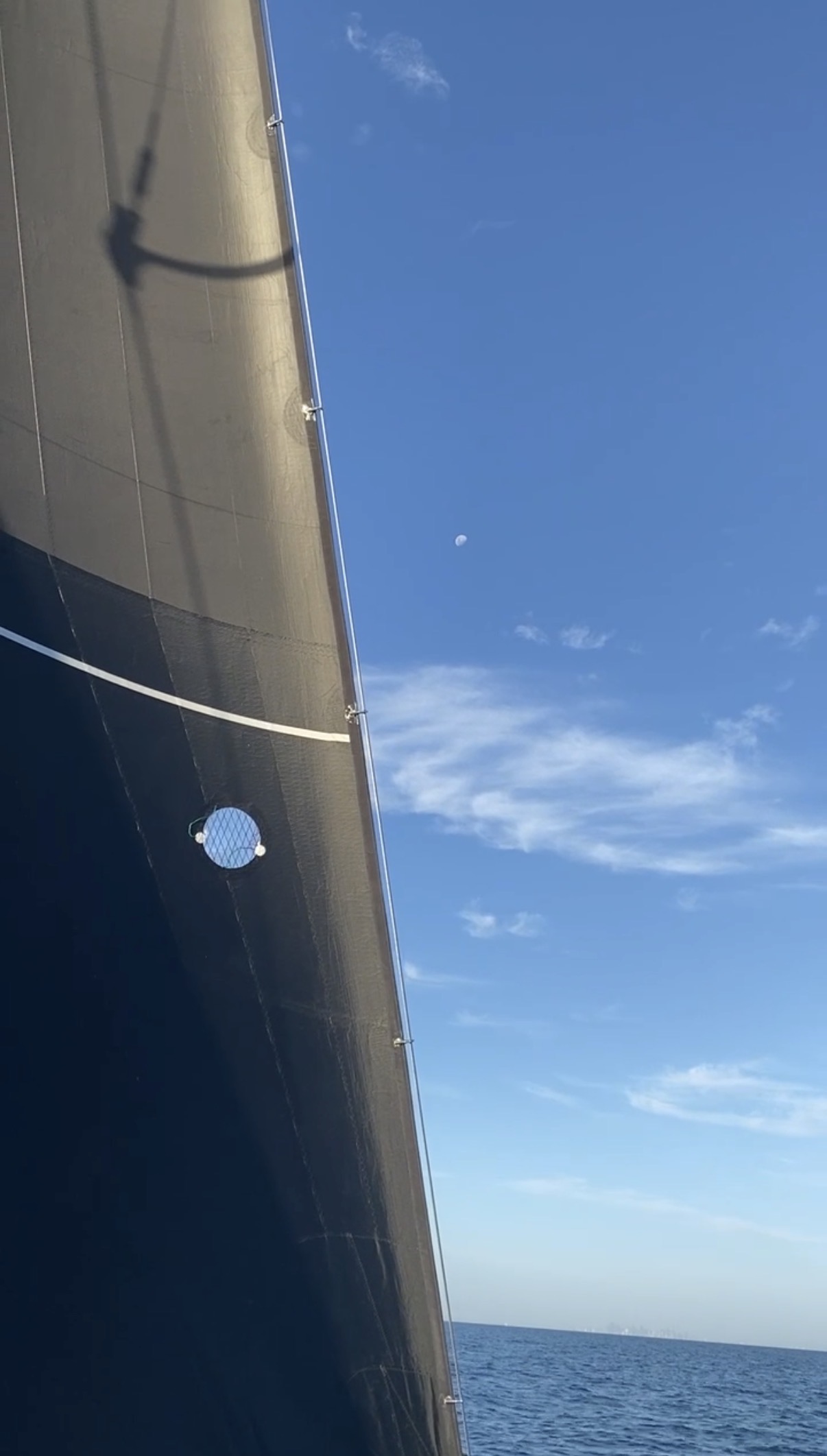
The second sail in the wardrobe was ordered after the owner had received his main, a huge compliment. A hanked J2, designed to cover the 12–30 knot range, which, on a Sydney Hobart, is where you spend most of your time. Hanked rather than tuff luff, because a hank-on sail gives you the ability to drop and re-set quickly without the mechanical complexity of a tuff luff requiring someone on the bow.
For shorthanded sailing, hanks have another advantage: you can drop the sail on the halyard and leave it attached to the forestay. No wrestling a furled sail off a headfoil, no risk of the drum jamming when you’re alone on the foredeck. You drop it, lash it, and it’s there ready to go back up when conditions ease.
The J2 was designed with reefing capability, effectively letting it perform as a J3.5. That’s two headsail sizes from one sail. For a fully crewed Hobart, you might carry dedicated J2 and J4 sails. But for the same boat sailing shorthanded, and preparing the boat on a budget, having one sail that covers two roles means fewer changes, less foredeck time, and less fatigue over a multi-day ocean race.
The Outcome
Built for the Hobart.
Ready for Everything After.
The 2024 Sydney Hobart was one of the toughest in recent memory — severe weather that led to tragic fatalities and a withdrawal rate of around 30%. For a crew of first-time Hobart sailors, the campaign objective was never about line honours or a podium. It was about getting to the finish safely and celebrating as a team at Customs House. They did exactly that.
The two-sail wardrobe performed across the full range of conditions the race threw at them. The main reefed progressively from full power in the light northerly start to deep third reef in the building southerly off Tasman Island — all managed from the cockpit without drama. The J2 set at the top mark and stayed up for the majority of the race, reefing down through the wind range rather than requiring a sail change. The crew reported that the transitions between reef states were smooth enough that they never felt under-canvassed or overpowered — the sail just moved with the conditions.
In a year where finishing was the achievement, having sails that the crew trusted completely — sails that did what they were supposed to do, every time, without surprises — made a real difference. And the wardrobe didn’t end with the Hobart. The same two sails are now the core of the owner’s shorthanded offshore program. No additional purchases needed, no modifications required. The sails were designed for both scenarios from day one, and they’re performing in both. That’s what wardrobe planning looks like when you get it right — you’re not buying sails for one race, you’re investing in a wardrobe that serves an entire campaign.
Planning Your Own
Campaign Wardrobe?
Whether it’s one sail or an entire wardrobe, we start the same way — by understanding your boat, your racing, and your crew. Let’s talk about what you need.