

Case Study
Sailing with Phoenix.
Oregon to Hawaii. Singlehanded.
Oliver had a medical diagnosis, a cat named Phoenix, and a dream that couldn’t wait. We built him sails that would get him from Oregon to Hawaii safely, and on Day 11 of his crossing, they proved why that mattered.
The Brief
A Dream That
Couldn't Wait.
Oliver was new to sailing. He’d bought an old Compac 33 and cashed out his retirement savings to fund a singlehanded crossing from Oregon to Hawaii, him and his cat, Phoenix. The urgency was real: a recent medical diagnosis suggested he might become paralysed, and he wasn’t prepared to let that window close without doing something extraordinary with it.
We found Oliver on social media and could see immediately that the sails on his boat, old, UV-damaged Dacron, were a serious risk. They were so blown out that they’d lost any meaningful upwind capability, which matters even on a predominantly downwind passage. If conditions turned and he needed to point upwind or heave to, those sails weren’t going to hold. Worse, there was a real chance they’d shred mid-ocean, leaving him halfway between the US mainland and Hawaii with not enough fuel to motor the rest of the way.
Oliver didn’t have the budget for advanced ocean racing sails, he didn’t even have the budget to replace them with a local franchise loft. But he had the determination, and he had the boat. Our job was to fill the gap between those two things.
At a Glance
Sailor: Oliver Widger
Boat: Compac 33
Passage: Oregon to Hawaii, singlehanded
Crew: Oliver + Phoenix (cat)
Sails delivered: Cross-cut main + storm jib
Construction: Heavy-duty Dacron, cross-cut
Key features: Deep reefs, full-length battens, bolt-through hardware
The Build
Ocean Racing Features.
Entry-Level Budget.
We sourced the most robust Dacron we could find, a heavy, honest cloth built for abuse rather than longevity. This wasn’t a sail that needed to look good on the club start line for ten seasons. It needed to survive an ocean crossing, singlehanded, on a boat that was going to be pushed hard by someone still learning the limits. We chose a fabric without the UV stabilisation treatments you’d specify for long-term ownership, because those treatments weren’t where Oliver’s budget needed to go. Every dollar went into structural performance.
Then we built it with the same features we put into our ocean racing sails. Deep reefs, the kind that let you reduce to a manageable sail area quickly and alone, without leaving the cockpit. Full-length battens to support the sail shape and reduce flogging in heavy air, because a singlehander can’t always get a reef in the moment conditions demand it. Bolted-through batten hardware rather than riveted or sewn pockets, so that if a batten end fitting failed mid-ocean, Oliver could remove and replace it with basic tools. Tie-in leech pockets for the battens that he could stitch back in if they wore through. Every detail was designed for the scenario where something goes wrong at sea and you’re the only person on board to fix it.
The Storm Jib
One of the differences between adventure sailing and ocean racing is that there’s no class rule, no regatta, and no oversight body preventing you from casting off your lines and heading offshore. Nobody checks whether you’re carrying the right safety equipment or the right sails. That freedom is part of what makes it compelling, but it also means there’s no safety net if the preparation falls short.
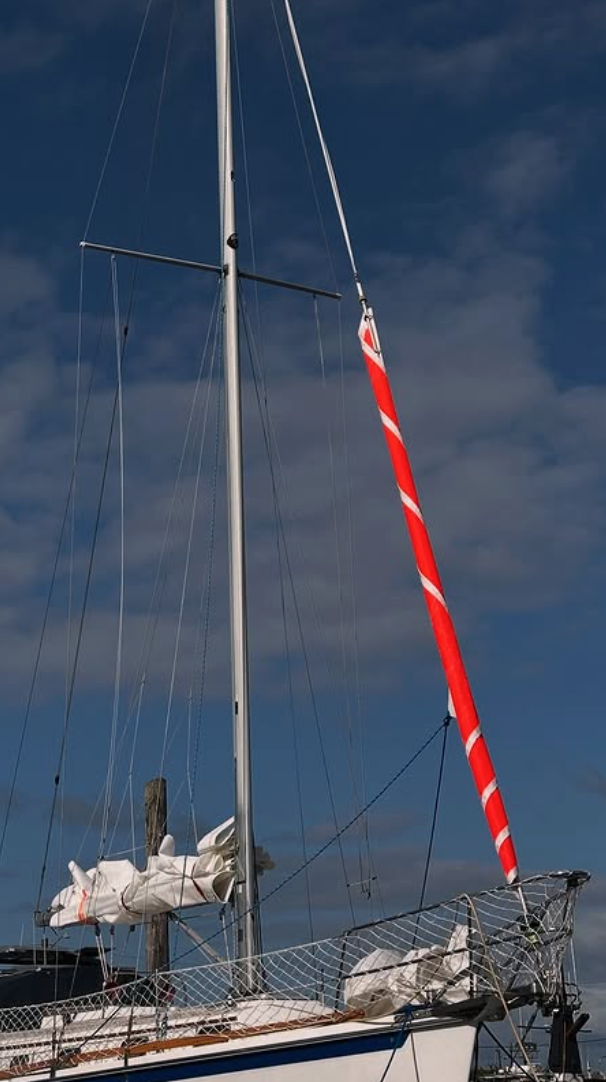
We knew Oliver also needed a storm jib. He might not have known that yet, but we did. A singlehander crossing to Hawaii needs the ability to heave to in survival conditions, and that means a small, bulletproof headsail that can hold the bow off the wind while you rest, repair, or simply wait for conditions to ease. Part of the deal was that we’d build him a well-priced ocean mainsail on the condition that we also provided a storm jib. We didn’t sponsor Oliver. But we did make sure he went to sea properly equipped, because that’s part of what we consider our responsibility when we’re building sails for someone heading offshore alone.
Day 11
Four Hours. 25 Knots.
No Rudder.
On Day 11, roughly the midpoint of the passage, Oliver lost his rudder. The steering connections failed and the boat rounded up into 25 knots of breeze with no steerage. For four hours, while he worked to regain control of the boat, the sails were flogging violently, the kind of sustained, punishing abuse that destroys lesser cloth in minutes. A sail flogging in 25 knots isn’t just flapping. It’s being snapped back and forth with the full force of the wind, over and over, with shock loads running through the panels, the seams, and the hardware at every reversal.
The sails held. Everything held. The deep reefs, the bolted-through battens, the heavy Dacron, all of it did exactly what it was built to do. Oliver later said that had he left Oregon with the old sails that were on the boat, they would have fallen apart that day. And at the midpoint of an ocean crossing, singlehanded, with a disabled rudder, losing your sails is the difference between a crisis you can manage and one you can’t.
The Outcome
Oregon to Hawaii.
Dream Delivered.
Oliver and Phoenix reached Hawaii to a lot of fanfare, and we were incredibly proud to have played a part in making it happen. By providing rock-solid, entry-level Dacron cross-cut sails built with ocean-grade features, we were able to facilitate a dream that might otherwise have ended badly somewhere in the middle of the Pacific.
This is what adventure sailing means to us. Not every customer is racing for a podium. Some are racing against something far more personal, and the sails need to be just as reliable — maybe more so, because there’s no support boat, no race committee, and no one coming to get you if things go wrong. We’re excited to be working with Oliver on his next project.
Planning Your Own
Adventure?
Whether it’s a Pacific crossing or a coastal passage, we build sails that match your boat, your budget, and the reality of what you’re actually going to face out there. Tell us where you’re heading.