

Adventure Sails
Your Boat Is Your Home.
Your Sails Have to Work.
We build custom sails for liveaboards, long-distance cruisers, and ocean voyagers who can’t afford a failure in the middle of nowhere. Durable, repairable, designed for your route.
Who We Build For
Are You an Adventure Sailor?
Adventure sailors aren’t weekend racers or fair-weather cruisers. You live aboard, cover serious miles, and sail in conditions that push both you and your gear to the limit. Your needs are specific, and so are our sails.
The Problem
Why Racing & Cruising Sails Both Let You Down
Most sailmakers think in two modes: race sails and cruise sails. Neither category is actually built for adventure sailing, and when you’re three weeks from port, that matters.
The real consequence of underbuilt sails: If your genoa tears itself to shreds in the middle of the Pacific and you don’t have enough fuel to motor home, you may be drifting onto a shipping lane waiting for a cargo ship. In many adventure sailing scenarios, you are beyond traditional search-and-rescue range. Your sails simply have to work.
Our Approach
Built for Years, Not Seasons
We prioritise durability, repairability, and ease of living with, sometimes at the expense of a few degrees of pointing ability. That’s the right trade-off for an adventure sailor.
Designed for How You Actually Sail
Features That Make Life Easier at Sea
A lot of sailors don’t realise there are ways to build sails that make them genuinely easier to live and work with. These aren’t performance features, they’re details that matter on a night watch 400 miles offshore. These aren’t all the details, but they’re a great place to start.
Solo & Shorthanded
The Overhead Leech Line
A standard leech line terminates at the clew or foot of the sail. That’s fine in a marina. On a reach offshore, the end of your boom is unreachable, and if your leech is vibrating in heavy air, the material is breaking down every minute it flogs.
We run an overhead leech line from the head of the sail down to the gooseneck so you can tension the leech from the cockpit at any point of sail. This isn’t a performance feature, it’s a sail longevity feature.
Clean Stack, Every Time
Reef Keepers & Low-Friction Rings
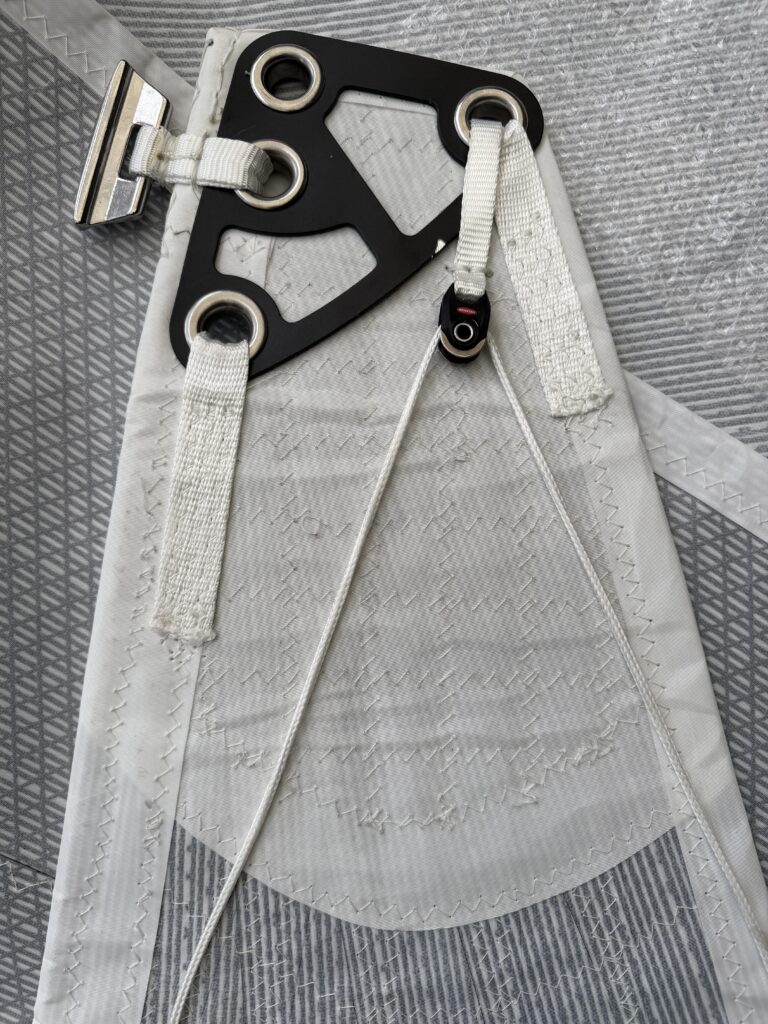
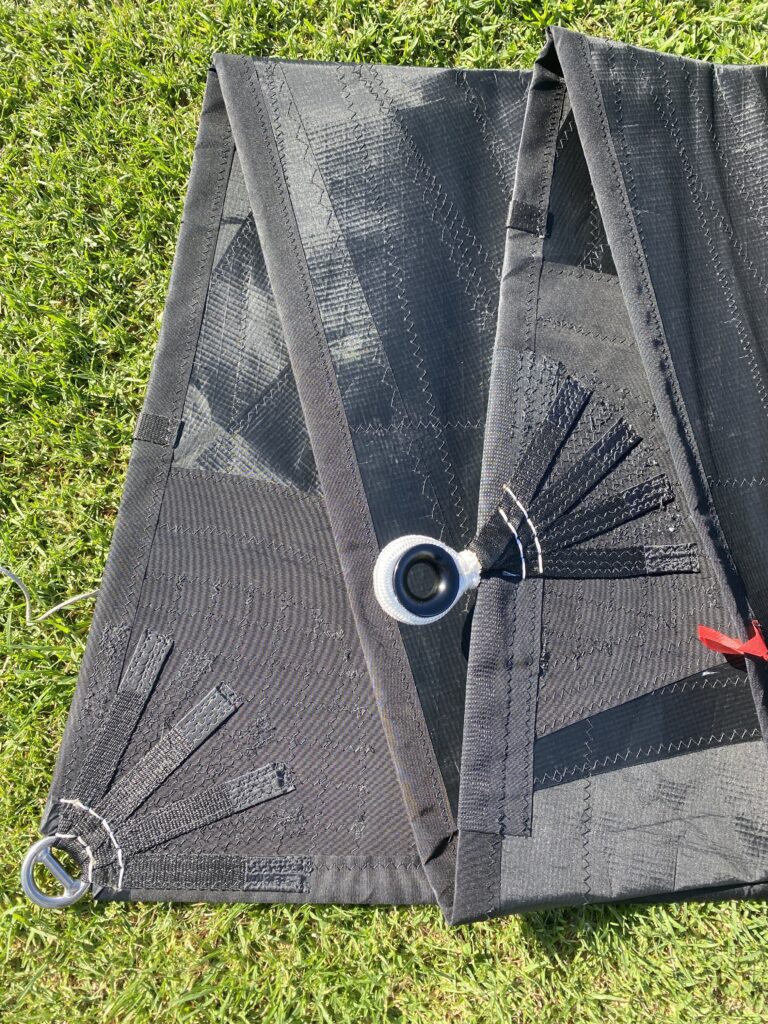
Reef keepers on the leech hold your reefing lines in against the sail when you’re sailing unreefed, no lines slapping in the breeze. When you do reef, the combination of reef keepers and full-length battens means your mainsail stacks neatly against the boom.
We also install low-friction rings on the leech stitched through with splayed Dyneema webbing. This gives a far more gradual turning angle for your reef line, dramatically reducing the load required to pull the reef in.
Storm-Ready Reef Depths
Reefs at the Right Heights
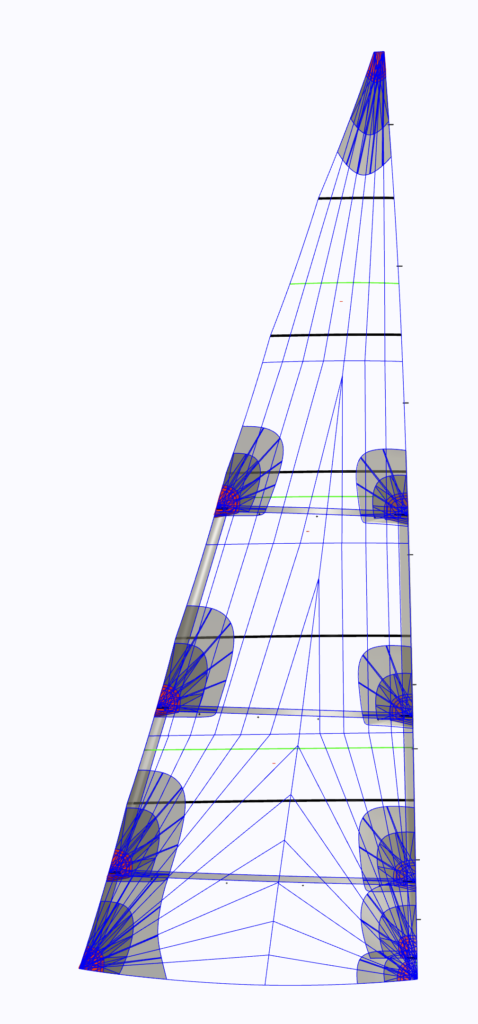
If your boom only has two reef lines, you may have them in the wrong places for adventure sailing. We discuss reef placement during the design phase, for most adventure sailors, we’d move one reef up to 1.5 on the luff, and set a deep storm-level reef at 40% of luff length.
That deep reef reduces your mainsail down to trysail size while keeping it on the boom, giving you control in severe conditions without having to go below for a separate storm sail.
High-Latitude Option
Fluorescent Orange Sail Head
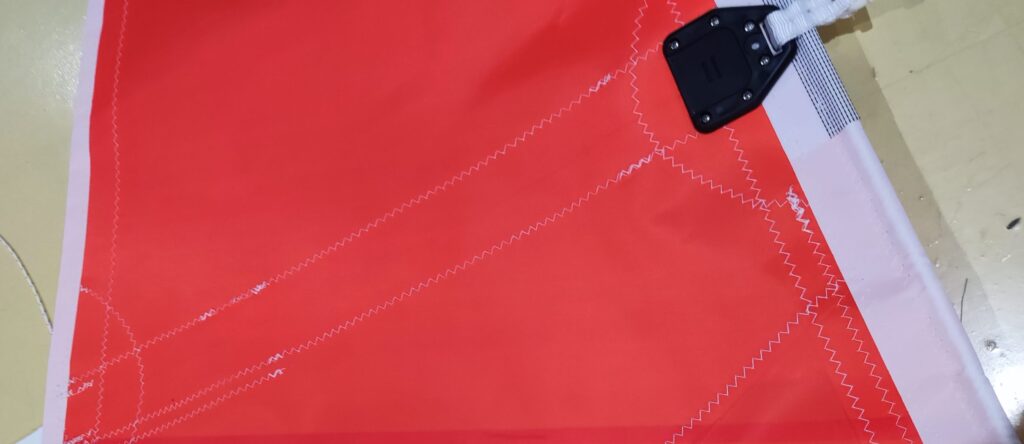
For sailors heading into areas with reduced visibility — fog, high latitudes, remote shipping lanes — we offer fluorescent orange sail heads. When visibility matters, a high-vis head makes your rig dramatically more conspicuous to commercial traffic.
It’s a simple option that costs little in production but can make a real difference in areas where SAR coverage is thin and commercial shipping is your backup plan.
Field Serviceability
Repairable At Anchor,
At Sea, Anywhere.
When we design for repairability, we’re thinking about what happens in an anchorage in the Marquesas where the nearest sailmaker is 1,500 miles away. Every fitting, every batten pocket, every cleat is chosen with that scenario in mind.
This is why we use bolted batten boxes rather than riveted — a bolted box can be disassembled and a damaged section replaced with simple hand tools. A riveted box cannot.
We also design with fabrics that can be hand-stitched at sea. Woven cloths are far easier to repair in the field than laminate membranes, which require specialist adhesives and conditions to re-bond properly.
REPAIRABILITY FEATURES — STANDARD ON EVERY ADVENTURE SAIL
- Bolted batten boxes: damaged sections replace without specialist tools
- Hand-stitched fittings: no rivets to corrode or fail in saltwater
- Woven cloth construction; can be hand-stitched and patched at sea
- Dyneema webbing at load points: longer-lasting, easier to inspect and replace
- Stitched cleats: replaceable if worn, even in a remote anchorage
- Thermoset UV treatment on cloth: prevents wholesale UV degradation that can’t be repaired
- Chafe patches at all reef contact points: stops wear before it becomes a tear
Custom to Your Route
Your Adventure Is Personal.
So Are Your Sails.
Off-the-rack designs work when what you’re doing is average. Adventure sailing isn’t average. We tailor your sail plan to your route, and we talk through your 1, 5, and 10-year plans so we can design for where you’re actually going, not just where you are now.
Tropical Passages
Caribbean & Trade Wind Routes
You’ll need a larger genoa for light-air power in the trades, but also a storm jib ready for when those trades turn ugly. We can build your storm jib with a Wichard luff that wraps over your furled genoa like a taco, keeping your foil clear.
Higher Latitudes
Patagonia, Southern Ocean & Beyond
Deeper reefs, storm-ready configurations, and a completely different cloth weight profile. The sail that takes you through the Caribbean may need a different deep reef or even a different storm sail specification for the Southern Ocean.
Offshore Sheeting
High-Cut Clew for Outboard Sheeting
If you’re going to be sailing the trades for extended periods, a higher-cut clew for outboard sheeting improves your downwind performance significantly. This design decision makes no sense off the rack but makes every sense for your specific plan.
We discuss your one-year, five-year, and ten-year plans during the design phase. Whether you’re spending next year in the Caribbean before heading through Panama and south to New Zealand, or going the other way round, we design your sails for the whole journey, not just the first leg.
No Middleman. No Off-The-Shelf.
Custom Adventure Sails
for Your Boat and Your Dreams.
Whether you’re a solo sailor, a couple chasing the horizon, or a family living aboard — we design custom sails that fit your boat, your route, and how you actually sail. And because we don’t have a middleman, we can do it for less than a traditional loft.